When a Simple Morning Turns Into a Painful Day
Autumn had arrived, and the weather was getting colder. After a night of less-than-ideal sleep, I woke up to find my neck suddenly stiff and almost numb. The slightest movement sent a sharp wave of pain through my neck.
I forced myself to finish breakfast and drove to work. Then my car hit a speed bump at the entrance to my residential community.
The jolt sent an intense bolt of pain through my neck. Even turning my head to check the rearview mirror became an ordeal that required real courage.
For the rest of the day, my neck felt like a block of wood. I tried not to move unless absolutely necessary, because every unnecessary movement seemed to trigger another explosion of pain.
Have you ever experienced something similar?
In Chinese, we call it luozhen (落枕) — waking up with a stiff neck. It is common, frustrating, and sometimes surprisingly painful.
But what actually happens when you wake up and suddenly cannot turn your head? Did you sleep in the wrong position? Did a muscle become injured overnight? And is there a way to relieve the pain without making things worse?
The answer begins with understanding what your neck is trying to tell you.
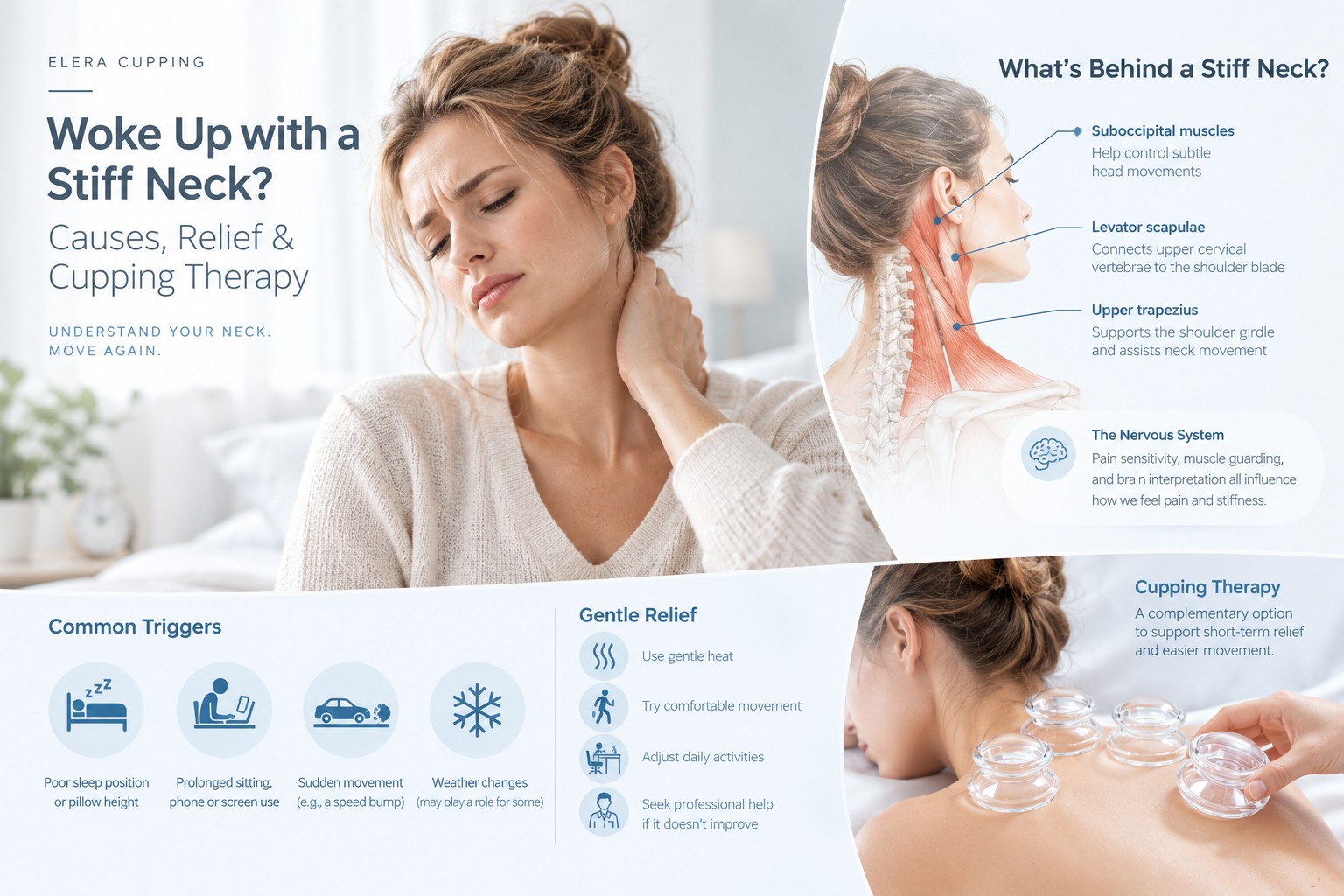
What Is a Stiff Neck, Really?
A stiff neck is not a single diagnosis. It is a symptom characterized by neck pain, muscle guarding, and reduced range of motion. When it develops suddenly after sleep, it is often associated with acute mechanical neck pain.
Several structures may contribute to the experience:
- The upper trapezius: This large muscle helps support and move the shoulder girdle and contributes to neck movement.
- The levator scapulae: Connecting the upper cervical vertebrae to the shoulder blade, this muscle can become sensitive when the neck and shoulder region is overloaded.
- The suboccipital muscles: These small muscles at the base of the skull help control subtle head movements and can contribute to pain around the upper neck.
- The nervous system: Pain sensitivity, protective muscle activity, and the brain's interpretation of movement all influence how stiff and painful the neck feels.
These structures do not work independently. They coordinate continuously to stabilize the head, orient the eyes, and allow us to look around.
When one region becomes sensitive, the surrounding muscles may increase their activity to protect it. This protective response is called muscle guarding.
The result can be a frustrating cycle: movement hurts, so you tense up; increased tension makes movement feel even more difficult; and you begin avoiding movements that would otherwise be safe.
Importantly, severe pain does not automatically mean severe tissue damage.
Why Does It Happen After Sleep?
There is rarely one universal explanation for waking up with a stiff neck. Several factors may contribute.
1. Sustained Position and Reduced Movement
During sleep, we naturally spend extended periods in relatively fixed positions. If your pillow height, sleeping posture, or mattress setup places your neck in an uncomfortable position, some tissues may experience prolonged loading.
A position that feels comfortable initially can become uncomfortable when maintained for hours.
This does not necessarily mean that you have damaged your neck. It may simply mean that the tissues and nervous system are temporarily less tolerant of movement in a particular direction.
2. A Sensitive Muscle Can Become Protective
If the neck and shoulder muscles are already fatigued from prolonged desk work, driving, or looking down at a phone, an additional period of sustained positioning may be enough to trigger symptoms.
The upper trapezius and levator scapulae are frequently involved in neck and shoulder discomfort. However, we should not assume that one specific muscle is always responsible for every episode of acute neck pain. If desk work is a recurring part of your week, our article on tech neck and shoulder tension covers the daily-load side of the picture.
Pain is often the result of several interacting factors rather than one isolated mechanical fault.
3. Why Does a Small Bump Hurt So Much?
Remember the speed bump in my story?
When the car jolted, my head and neck experienced a sudden acceleration. If the neck was already painful and sensitive, that unexpected movement could provoke a strong protective response.
This helps explain why seemingly minor movements can feel disproportionately painful during an acute episode.
The pain is real. But pain intensity alone cannot tell us precisely which tissue is involved or how much damage has occurred.
4. Is Cold Weather the Cause?
Many people associate stiff necks with cold weather or sleeping with a fan or air conditioner directed at the body.
Cold may influence comfort, muscle activity, and pain sensitivity in some people. However, there is not enough evidence to conclude that cold exposure alone causes most episodes of acute neck pain.
It is more useful to consider the complete picture: sleep position, recent activity, existing muscle fatigue, stress, and individual pain sensitivity.
Why Forcing Your Neck to Turn Can Backfire
When your neck feels locked, the natural instinct is to stretch it harder, twist it until it cracks, or ask someone to pull it back into position.
This is understandable — but it is not always helpful.
During an acute episode, the nervous system may increase muscle guarding around a painful movement. Forcing the head through a painful range can provoke additional discomfort and reinforce the sense that movement is threatening.
That does not mean you should keep your neck completely still.
In most uncomplicated episodes of acute mechanical neck pain, gentle, tolerable movement is preferable to prolonged immobilization.
The goal is not to force the neck to achieve its full range immediately. It is to gradually restore comfortable movement without repeatedly provoking intense pain.
Think of it this way: the neck does not necessarily need to be forced back into place. It may need the opportunity to move safely again.
What Should You Do When You Wake Up With a Stiff Neck?
For a typical episode without warning signs, a few simple strategies may help.
1. Use Comfortable, Gentle Movement
Start with small movements within a comfortable range.
You might slowly turn your head a few degrees to either side, gently nod, or make small shoulder movements.
Keep the movement smooth and controlled. Do not bounce, force the end range, or push through sharp pain.
As symptoms settle, gradually increase the range of movement.
2. Try Gentle Heat
A warm shower or a comfortably warm compress may help reduce the feeling of stiffness and make movement more comfortable.
Use moderate heat and protect your skin. Avoid very hot applications, particularly if sensation is reduced.
Heat is a comfort measure, not proof that the problem is caused by cold or that a specific tissue has been repaired.
3. Adjust Your Daily Activities
You do not necessarily need to cancel every activity, but you may need to modify it temporarily.
- Take regular breaks from prolonged desk work.
- Keep frequently used screens at a comfortable viewing height.
- Avoid sudden, forceful neck movements.
- Use a pillow that keeps your head and neck reasonably aligned.
- Do not drive if you cannot turn your head sufficiently to check traffic safely.
A short period of modification can help you remain active without repeatedly aggravating symptoms.
4. Consider Professional Assessment
If pain is severe, movement is substantially restricted, symptoms are worsening, or the problem is not improving over several days, consult a qualified healthcare professional.
A clinician can assess your movement, neurological function, medical history, and possible causes before recommending treatment.
Can Cupping Help a Stiff Neck?
This is where myofascial cupping becomes relevant — but it is important to understand both its potential and its limitations.
Traditional massage generally applies pressure to soft tissue. Silicone cupping uses negative pressure to lift the skin and superficial soft tissues.
This difference in mechanical input may influence local sensory signals and how a person experiences discomfort during movement.
1. A Different Way to Apply Mechanical Input
When a muscle is sensitive, repeatedly pressing directly into the painful area may be uncomfortable.
Cupping applies a pulling force rather than the downward compression used in many massage techniques. For some people, this alternative sensory input may be more tolerable and may help temporarily reduce discomfort.
However, we should not assume that a painful muscle contains tissue that must be physically pulled apart or that the cup is correcting a structural problem. For a closer look at what negative pressure actually does, see our breakdown of the science of cupping.
2. Creating an Opportunity for Movement
The most useful question is not simply whether cupping can make pain feel better.
It is whether temporary symptom relief helps the person perform movements that were previously difficult.
For example, a qualified practitioner might use a brief, low-intensity cupping application over appropriate soft tissue around the upper shoulder region, then reassess comfortable neck movement.
If movement becomes easier, gentle active movement can follow. This sequencing is the same logic we set out in Cupping Isn't Pain Education — It's the Doorway to Movement.
The cup is an optional tool. The goal is to restore comfortable movement and function.
3. What Does the Evidence Say?
Systematic reviews have reported promising results for cupping in people with neck pain, including short-term reductions in pain. However, much of the available research has limitations, including differences in treatment methods, study quality, and participant populations.
Crucially, research involving chronic neck pain or broader neck-pain conditions does not automatically establish that cupping is effective for every episode of acute stiff neck.
Cupping should therefore be considered a possible complementary intervention — not a guaranteed cure or a substitute for appropriate medical assessment.
Important Safety Precautions
The neck is an anatomically sensitive region. Cupping should not be applied indiscriminately.
- Never apply suction directly to the front of the neck. This region contains important blood vessels, nerves, and other vulnerable structures.
- Avoid forceful suction, aggressive manipulation, or prolonged stationary cupping over sensitive neck tissues.
- Do not attempt to treat unexplained severe neck pain with cupping before appropriate assessment.
- Seek professional advice before cupping if you have a bleeding disorder, take anticoagulant medication, have fragile skin, or have another condition that increases the risk of injury.
- Stop if treatment causes significant pain, dizziness, numbness, or other unusual symptoms.
Seek Urgent Medical Attention If
Neck stiffness is accompanied by fever and a severe headache, confusion, light sensitivity, or a rash; symptoms follow a significant injury; or you develop new or progressive arm or leg weakness, difficulty walking, or other significant neurological symptoms. Sudden severe neck pain accompanied by unusual headache, dizziness, visual changes, or difficulty speaking also requires urgent evaluation.
These symptoms should not be assumed to be an ordinary stiff neck.
The Takeaway: Your Neck Is Sensitive, Not Necessarily Damaged
Waking up with a stiff neck can be intensely uncomfortable. Even a small bump in the road can make an already painful movement feel unbearable.
But a stiff neck does not automatically mean that a vertebra is out of alignment, a muscle is torn, or the fascia is stuck. For a more detailed look at what fascial restriction does and does not mean, read Fascia: The Ignored Organ.
In many uncomplicated cases, symptoms improve with time, comfortable movement, and appropriate self-care. More persistent or concerning symptoms deserve professional assessment.
Myofascial cupping may help some people manage neck discomfort in the short term. Its most sensible role is as a complementary option that supports comfortable movement — not as a mechanical reset that must happen before the neck can function again.
At ELERA Cupping, we believe that understanding the body matters as much as choosing the right tool. Effective care begins with appropriate assessment, controlled treatment, and a gradual return to movement. For practitioners, our Classic Mushroom and Clear Straight ranges are built around controllable suction, soft gliding edges, and transparent walls that let you watch the skin respond during a session.
The goal is not simply to make the pain disappear for a moment. It is to help you move with greater comfort, confidence, and control.
Disclaimer: This article is for educational purposes only and does not constitute medical advice. It is not a substitute for professional diagnosis or treatment.
Built for Controlled, Comfortable Application
ELERA supplies medical-grade silicone cupping systems for clinics, sports therapy practices, and distributors — with controllable suction, soft gliding edges, and transparent cups for real-time observation. Contact our B2B team for wholesale pricing, samples, and OEM customization.
Request a Quote