Meet your next patient: a 35-year-old marathon runner complaining of chronic, unyielding tightness in her IT band. She has tried foam rolling, deep tissue massage, and even dry needling, but the myofascial adhesions simply won't release. You reach for your ELERA silicone cupping set, apply a smooth, gliding negative pressure, and within minutes the reactive hyperemia begins. The fascia yields.
But as you glide the cups across her skin, have you ever stopped to consider the material itself? In the world of myofascial decompression, the tool is an extension of your hands. If the material is flawed, the therapy is compromised. Today we are pulling back the curtain on the unsung hero of modern cupping therapy: medical-grade silicone.
The Accidental Miracle: Two Paths to a Clinical Standard
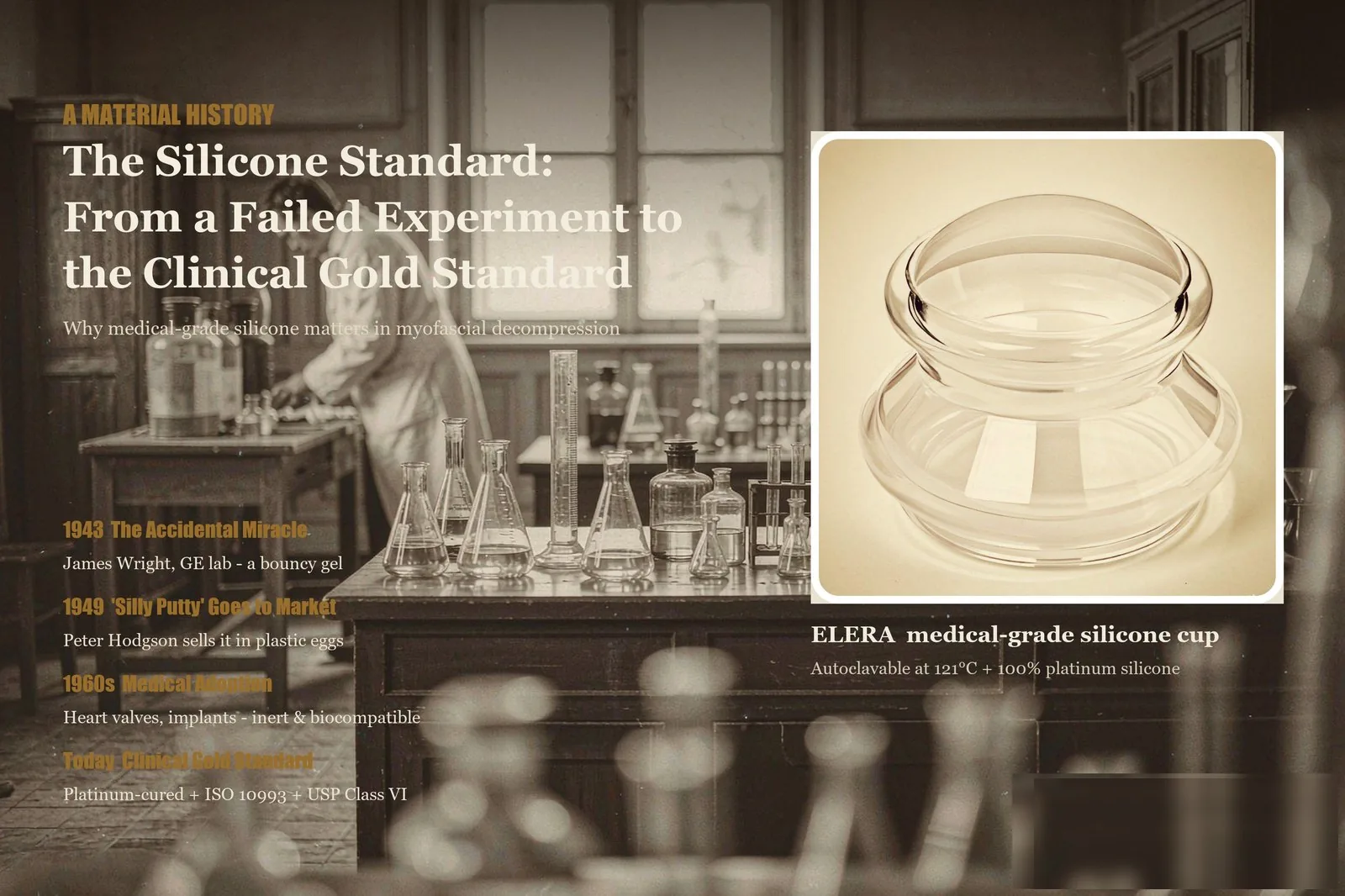
The story of modern silicone is rooted in a true scientific breakthrough. In 1943, engineer James Wright was working in a General Electric laboratory in New Haven, Connecticut, hunting for a synthetic rubber substitute during World War II. His experiments produced a strange, gooey, bouncy material — neither solid nor liquid. It could stretch and bounce far better than rubber, and it resisted decay. But it lacked the tensile strength needed for tires or equipment, so it languished as a laboratory curiosity. In 1949, marketing consultant Peter Hodgson recognized its potential as a toy, named it "Silly Putty," and launched it in plastic eggs the following year.
Meanwhile, a separate line of research was quietly building the real foundation of medical silicone. In the 1930s, organic chemist James Franklin Hyde — the "Father of Silicones" — developed organosilicon compounds at Corning Glass Works that combined the stability of glass with the flexibility of plastics. His work directly led to the formation of Dow Corning in 1943, and these silicones went on to serve in insulation, sealants, and medical devices. By the 1960s, researchers recognized that silicone possessed another extraordinary trait: physiological inertness. It proved biocompatible, non-toxic, and non-allergenic in use, and the medical field quickly adopted it for everything from artificial heart valves to implants. Today, medical-grade silicone has evolved into the premier material for external therapeutic tools, bridging the gap between ancient healing arts and modern material science.
The Science of the Material: What Makes It "Medical-Grade"?
Medical-grade silicone is not merely "cleaner" rubber — it is a highly engineered organosilicon polymer. Its backbone consists of alternating silicon and oxygen atoms (-Si-O-Si-), combining the thermal stability of inorganic materials with the flexibility of organic polymers.
To earn the title of "medical-grade," the raw material must undergo rigorous refinement. It is synthesized using a platinum-catalyst curing process in a cleanroom environment to ensure high purity and a low residual content of unreacted monomers. This reduces toxic byproducts and supports compliance with biological-safety standards such as ISO 10993 (Biological Evaluation of Medical Devices) and USP Class VI, which assess biocompatibility rather than purity alone.
This purity translates to three critical clinical benefits:
- Unmatched Biocompatibility: Medical-grade silicone is associated with negligible irritation, cytotoxicity, and allergic potential, even during prolonged, high-friction gliding cupping sessions.
- Thermal & Chemical Stability: It withstands repeated high-temperature autoclave sterilization without degrading, warping, or leaching chemicals.
- Optimal Viscoelasticity: It provides a well-tuned balance of suction memory and tissue glide, ensuring consistent negative pressure without causing micro-tears in the epidermis.
The Great Divide: Medical-Grade vs. Ordinary Silicone
Walk through any commercial marketplace, and you will find cupping sets marketed as "silicone" at a fraction of the cost. But as a clinician, you must understand the chasm between ordinary (or even food-grade) silicone and true medical-grade silicone.
- Chemical Purity & Toxicity: Ordinary silicone often uses cheaper sulfur-based vulcanization and may contain unreacted monomers, plasticizers, or heavy metals. Under the friction and heat of cupping therapy, these impurities can migrate into the skin, causing contact dermatitis. Medical-grade silicone uses platinum curing, keeping toxic leaching to negligible levels.
- Manufacturing Environment: Industrial silicone is produced in standard factories. Medical-grade silicone is manufactured in ISO 14644-1 Class 7 (or better) cleanrooms, strictly controlling microbial and particulate contamination.
- Mechanical Durability: Cheap silicone degrades over time, becoming sticky, discolored, or brittle. Medical-grade silicone retains its high tear strength and elasticity for years, even after repeated sterilization cycles.
The core takeaway: Using ordinary silicone for myofascial decompression is akin to performing surgery with unsterilized instruments. The risk of adverse skin reactions directly contradicts the healing intent of the therapy.
Clinical Protocol: Maximizing the Material's Potential
To leverage the superior properties of medical-grade silicone in your practice, adhere to these guidelines:
Sterilization
Always autoclave your ELERA medical-grade silicone cups at 121°C for 20 minutes (or a validated 134°C pre-vacuum cycle of 3–4 minutes) between patients. The material will not degrade; it will remain pristine.
Lubrication
Use high-quality, hypoallergenic massage oils or gels. The non-porous surface of medical-grade silicone allows for seamless dynamic cupping without absorbing the lubricant.
Inspection
Before each session, visually inspect the cup rim. While medical-grade silicone is highly durable, any sign of structural compromise warrants immediate replacement to prevent skin pinching.
Safety Precautions & Contraindications
While medical-grade silicone minimizes the risk of material toxicity, standard cupping contraindications still apply. Do not apply negative pressure over open wounds, active infections, deep vein thrombosis, or unhealed surgical scars. Always perform a patch test on patients with known severe contact allergies, though the incidence of reaction to medical-grade silicone is virtually zero.
The Foundation of Healing
In myofascial decompression, we ask the body to release decades of stored tension. We rely on the precise application of negative pressure to trigger mechanotransduction and restore homeostasis. Your tools must be as uncompromising as your clinical standards.
Uncompromised safety, backed by material science
Discover how ELERA's certified medical-grade silicone cupping sets support strict clinical protocols and professional standards.
Request a Quote