The Illusion of "Weak" Muscles in Sports Rehab
In elite sports rehabilitation, practitioners constantly encounter athletes who present with severe muscle imbalances. A common scenario: an athlete with a history of knee pain struggles to engage their gluteal muscles during a squat. They squat heavy, yet their glutes feel completely inactive, forcing the quadriceps to overcompensate.
The traditional assumption is that the glutes are simply "weak" and need more resistance training. However, the true problem is often not in the muscle tissue at all—it is in the brain.
This phenomenon is known as Arthrogenic Muscle Inhibition (AMI). To protect a compromised joint, the Central Nervous System (CNS) actively downregulates the efferent (motor) signals to surrounding musculature. The muscle hardware is fully intact, but the neurological software has turned the muscle "off." You cannot strengthen a muscle that the brain refuses to use.
To break this cycle of inhibition, sports medicine requires a tool that provides massive sensory disruption. Enter Functional Cupping.
The Afferent Barrage: Changing the Cortical Map
How do we force the brain to turn a muscle back on? The answer lies in the skin and superficial fascia, which are densely packed with mechanoreceptors (Ruffini endings, Pacinian corpuscles, and interstitial receptors).
In a technique known as Active Myofascial Decompression (AMD) or Functional Cupping, a clinical practitioner applies a silicone cupping device directly over the inhibited muscle (e.g., the gluteus maximus or vastus medialis) and instructs the athlete to perform the functional movement, such as a deep squat.
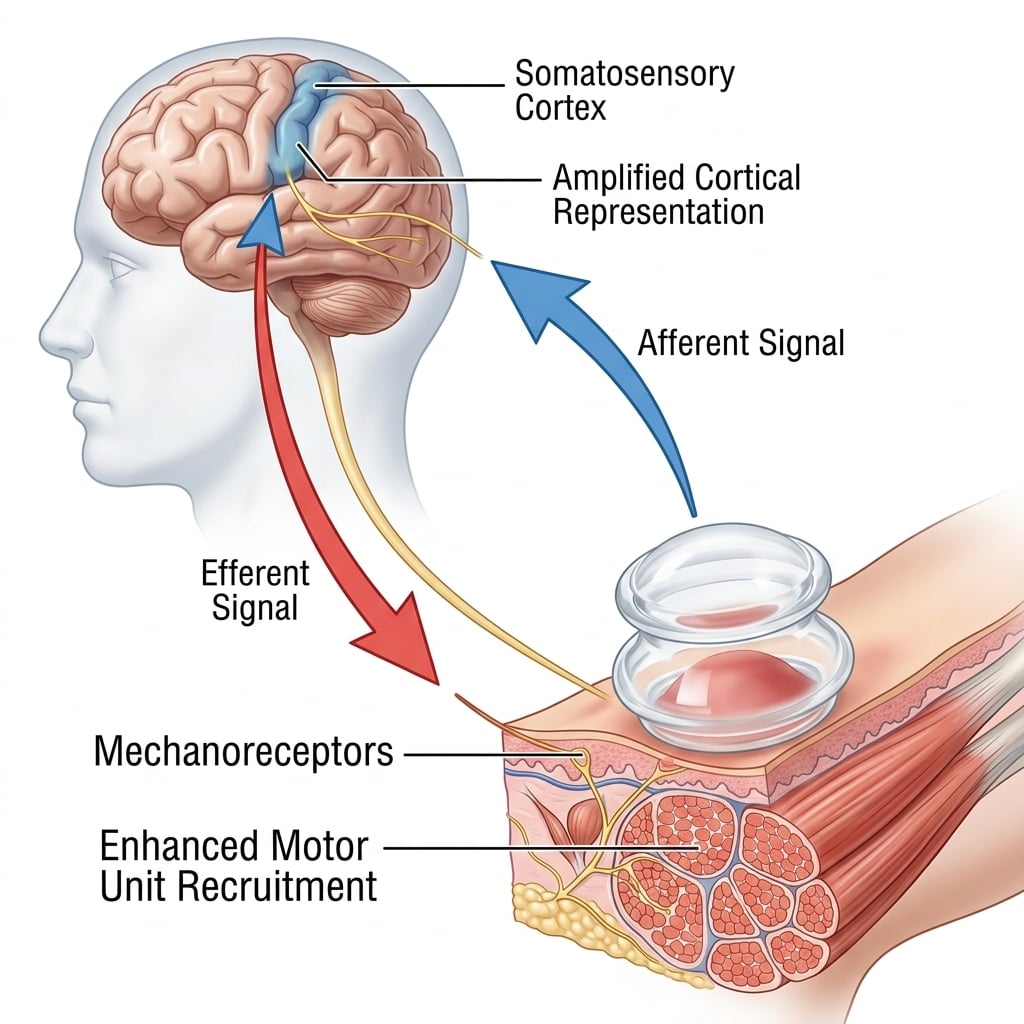
The Neurophysiological Technique:
- Highlighting the Map: Because of the previous injury, the representation of the glute on the brain's "cortical map" was diminished. The massive sensory feedback from the cup acts like a highlighter, forcing the brain to acutely perceive the specific location and tension of the inhibited muscle.
- Enhanced Motor Unit Recruitment: Faced with this intense localized stimulus, the brain responds by amplifying the Efferent (Motor) Signal sent back down to the muscle to stabilize the tissue.
- Immediate Perceptible Activation: The athlete, who previously could not feel their glutes firing, often experiences immediate perceptible muscle activation during the movement. The neurological pathway has been actively engaged.
The Requirement for Pure Silicone
The efficacy of Functional Cupping is entirely dependent on the material of the tool.
If a practitioner attempts this technique with traditional rigid glass fire cups or hard plastic pump cups, failure is inevitable. As the muscle belly expands during contraction, the rigid edges will painfully dig into the tissue, triggering a sympathetic pain response that further inhibits muscle function. Furthermore, the slightest alteration in bone or joint angle will break the rigid vacuum seal, causing the cup to immediately pop off.
This advanced neurological technique requires 100% Medical-Grade Platinum Silicone Cupping Sets.
- Dynamic Elongation: Premium silicone possesses high elasticity. As the athlete moves through extreme ranges of motion, the silicone cup warps, twists, and elongates in perfect synchronization with the underlying fascial planes.
- Unbreakable Adhesion: By applying a light emollient, silicone cups maintain an aggressive vacuum seal regardless of muscle deformation, delivering uninterrupted mechanoreceptor stimulation throughout the entire eccentric and concentric phases of the squat.
Limitations & Current Evidence
While the clinical outcomes of Active Myofascial Decompression (AMD) are highly promising in sports rehabilitation, it is important to maintain evidence-based expectations. Current physiological research strongly supports the mechanisms of mechanotransduction and cutaneous afferent stimulation in altering motor control. However, cupping is not a standalone cure for structural joint damage or severe neurological deficits. It should be utilized as an advanced adjunct therapy—a "neurological window of opportunity"—that allows physical therapists to temporarily bypass pain and inhibition, enabling the patient to perform the necessary strength and loading exercises that drive long-term structural adaptation.
By utilizing silicone cups during active movement, practitioners elevate cupping from a passive recovery modality into a high-performance neurophysiological tool. It is no longer just about blood flow; it is about rewriting the connection between the brain and the body.
Elevate Your Sports Rehab Practice
Equip your facility with the industry standard for Active Myofascial Decompression. Contact our B2B team for wholesale pricing and OEM customization on our Medical-Grade Platinum Silicone Sets.
Partner With Us