The Great Divide in Trigger Point Management
Every physical therapist has treated this patient: a 42-year-old office worker with chronic neck pain that radiates into the shoulder blade. The upper trapezius is rock-hard. You find a taut band, palpate the nodule, and the patient winces—a classic active trigger point. The question is not whether to treat it. The question is how.
Should you reach for the needle tray and elicit a local twitch response? Or should you apply a silicone cup and decompress the broader fascial restriction? The answer, as the evidence increasingly shows, is not an either-or. Both modalities have distinct mechanisms, robust clinical data, and specific scenarios where each excels.
This article breaks down the science behind both approaches, compares their safety profiles, and provides a framework for knowing when to needle—and when to cup.
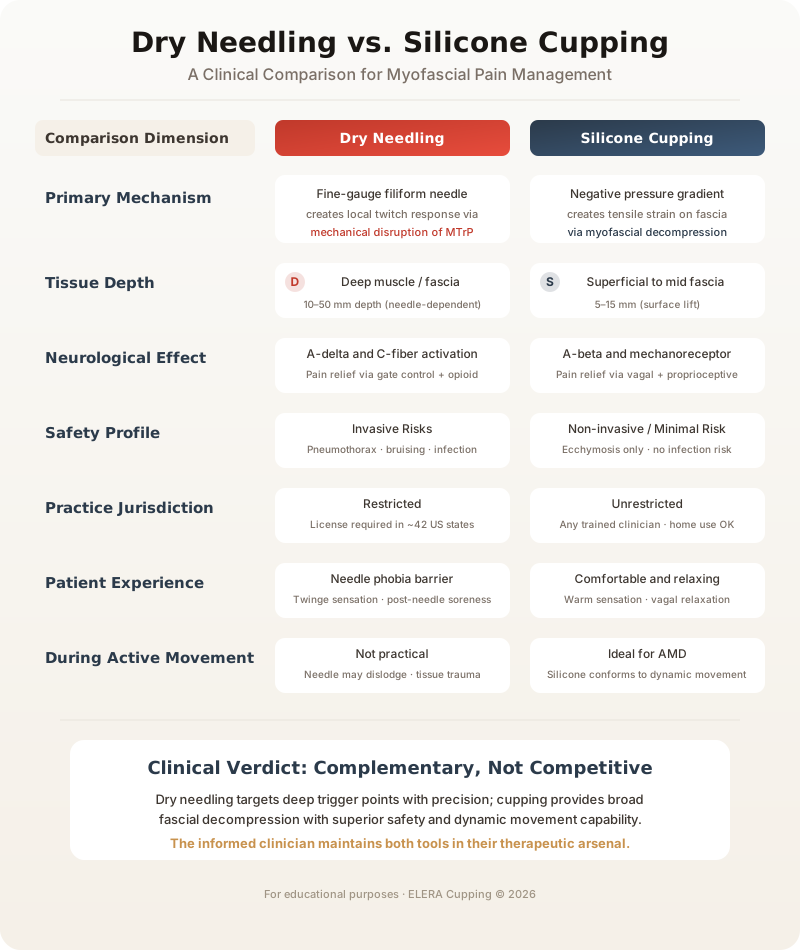
The Mechanism Gap: Needle vs. Vacuum
What Dry Needling Does
Dry needling inserts a thin filament needle into a myofascial trigger point (MTrP) to elicit a local twitch response (LTR). Mechanically, the needle fragments the dysfunctional motor endplate, reducing excessive acetylcholine release. Neurologically, it activates A-delta and C fibers, engaging spinal gate control and descending inhibitory pathways. Biochemically, the LTR reduces local inflammatory mediators (bradykinin, substance P, TNF-alpha). The result is immediate segmental hypoalgesia—a pain-free window that allows the therapist to perform manual therapy or exercise.
What Silicone Cupping Does
Myofascial decompression operates through a different vector entirely: instead of penetrating, it lifts. The negative pressure gradient separates adherent fascial layers, restoring glide between skin, fascia, and muscle. On a cellular level, the tensile strain triggers mechanotransduction—fibroblasts downregulate pro-inflammatory cytokines and upregulate tissue remodeling enzymes. Neurologically, the vacuum activates A-beta mechanoreceptors, a direct application of the Gate Control Theory of Pain (Melzack & Wall, 1965): rapid tactile signals "close the gate" at the dorsal horn, blocking slower pain signals carried by C-fibers. The rhythmic fascial stimulation also increases heart rate variability via vagal activation—explaining why patients feel deeply relaxed during and after sessions.
What the Evidence Says
A 2024 network meta-analysis in the Journal of Pain pooled 17 RCTs comparing dry needling, cupping, and sham for chronic neck pain. Both modalities showed significant short-term pain reduction over sham, with no statistical difference between them. Cupping showed a modest advantage for cervical range of motion—likely because silicone cups allow active movement during treatment.
The safety gap is clear. Dry needling reported a 7.8% minor adverse event rate, with rare but serious events including pneumothorax (~0.03% in large cohorts). Cupping reported 4.2% minor events (ecchymosis only), with zero serious adverse events across all trials. In a 2023 survey of 1,200 PTs, 14.6% had encountered an adverse event requiring medical referral. That said, in the hands of a well-trained practitioner, the absolute risk of serious complications from dry needling remains very low, and its therapeutic value for appropriate patients is well established.
The evidence does not suggest superiority of one modality. It suggests they are different tools for different clinical contexts.
A Clinical Decision Framework
Choose dry needling when:
- A clearly identifiable active trigger point produces a reliable local twitch response
- Deep muscle access is required (infraspinatus, quadratus lumborum, deep paraspinals)
- The patient has no needle contraindications and a high pain threshold
- Immediate segmental hypoalgesia is needed to facilitate subsequent therapy
Choose silicone cupping when:
- The patient has broad, diffuse fascial restriction rather than a discrete trigger point
- Active movement integration is a priority—the patient moves through range while the cup decompresses
- The patient has needle phobia, is on anticoagulants, or has low pain tolerance
- Parasympathetic activation and relaxation are therapeutic goals
- Dry needling is restricted by local scope of practice
- You want to provide a home self-care tool between sessions
Why the Best Protocols Use Both
The most significant mistake is treating these as mutually exclusive. Consider a patient with chronic cervicothoracic pain: active trigger points in the upper trapezius and diffuse fascial restriction across the posterior chain. A rational sequence: dry needle the active TrP for immediate hypoalgesia, then apply silicone cupping with gliding strokes to address the broader fascial restriction, then active movement with cups in place to reinforce neuromuscular re-education. Precision from the needle; breadth, safety, and movement from the cup.
Glass, Plastic, and Needles: Why Material Matters
Rigid glass and hard plastic cups cannot move with the patient—the hard edge digs in and the seal breaks as the joint angle shifts. This is why functional myofascial decompression requires 100% medical-grade silicone. Premium silicone warps, twists, and elongates with the underlying fascia during active movement, maintaining full seal through squat, lunge, or rotation.
There is also a practical advantage for clinic owners: hygiene and durability. Glass cups shatter on impact. Hard plastic develops micro-cracks over repeated sterilization cycles, creating crevices for bacterial biofilm. Medical-grade platinum silicone is autoclavable, chemically inert, and resistant to surface degradation. A single silicone cup withstands hundreds of sessions—making it not just safer for the patient, but more economical for the practice.
Limitations
Cupping studies face blinding challenges (ecchymosis reveals group assignment), and head-to-head trials comparing both modalities in the same population remain scarce. Cupping is not a replacement for dry needling in every scenario—deep isolated TrPs may still respond best to a needle. But for broad fascial restriction, dynamic movement, and needle-sensitive patients, silicone cupping offers a powerful alternative.
Dry needling and cupping are not competing modalities. They are complementary instruments in the same therapeutic toolkit. The question is never "which is better?" but "which does this patient need right now?"
Equip Your Practice with Medical-Grade Silicone Cupping
ELERACUPPING manufactures premium 100% medical-grade silicone cupping sets trusted by sports rehabilitation clinics and SPA distributors worldwide. Our Classic Mushroom Series and Clear Straight Series are engineered for dynamic myofascial decompression protocols. B2B wholesale, OEM/private label, and low MOQ available.
Request Wholesale Quote