The AI wave is rising. Most of us are not building it — we are simply standing in the flood.
It is moving faster than any of us can keep up. Jobs are being rewritten, and one by one the things that used to need a human no longer seem to. We lean on AI for a little more every day, and underneath it all the quiet question keeps getting harder to ignore: am I about to be swallowed whole? If more and more of the work is done by machines, what will I still be for? What value do I have left — I, an ordinary person, standing in front of a machine that can already do almost everything?
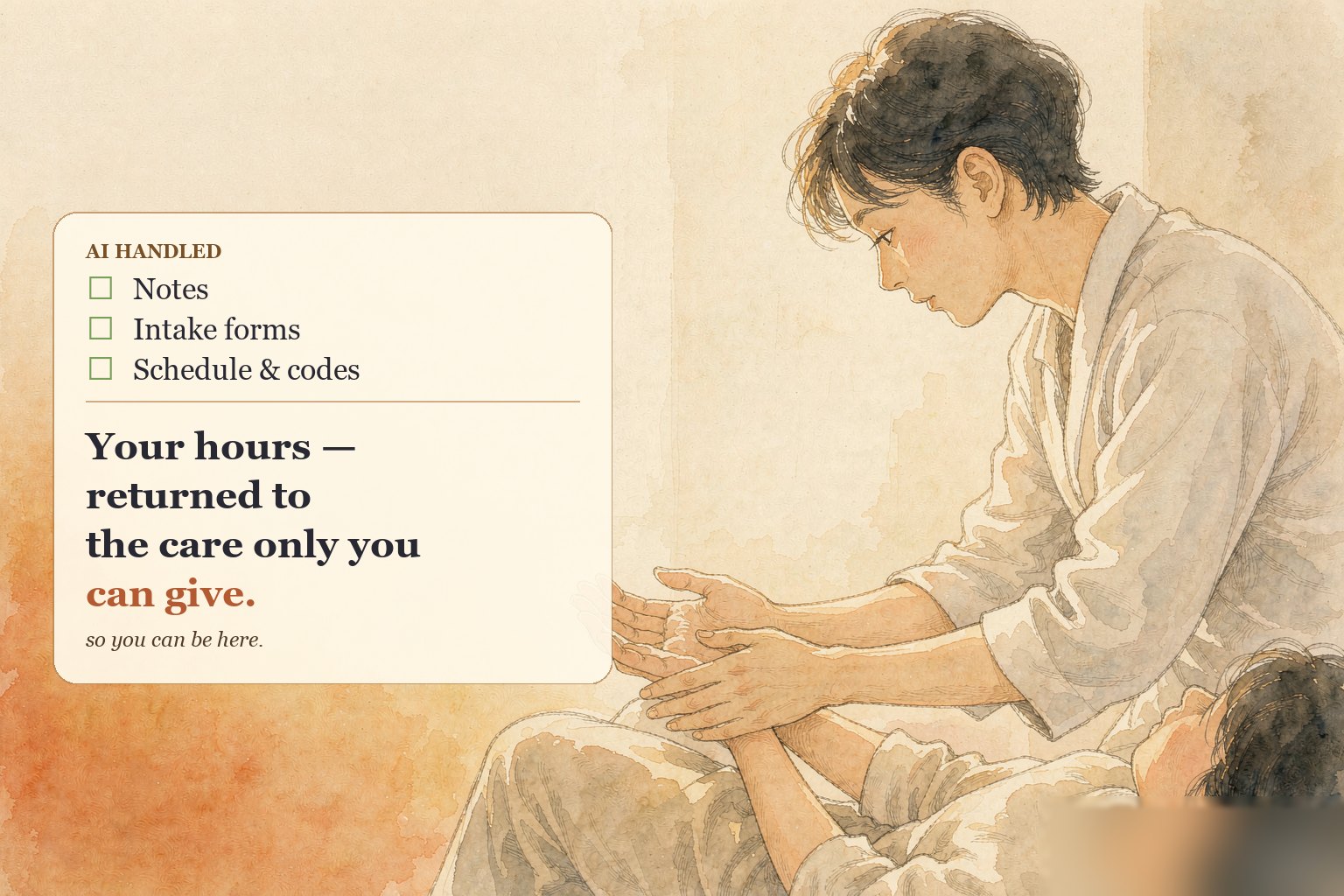
That fear is honest, and you are not alone in it. But look closely at which work the flood actually carries away — and which it cannot touch. Almost everything that can be reduced to information is being automated, and fast. The work that survives is the work that was never information to begin with: the kind that lives in presence, in a body, in one person's quiet care for another. It is work you cannot see from a screen — which is exactly why no screen will ever take it.
Touch Was Never Information
Your hands know things no one ever taught them in words. A machine can describe adhered fascia with perfect clinical accuracy, yet it will never feel that exact moment of resistance that tells a trained touch, here, not there, and not a single gram more. That knowing was never written down. It was earned, quietly, visit after visit, in the space between your fingertips and another person's body. No model was ever taught by touch — because touch cannot be downloaded. It can only be lived.
And it is not only your hands that see. No screen can catch the small wince that means too much, or the change in a breath when you finally reach the place that matters, or the way a shoulder lets go when a person stops holding their whole life inside it. A machine reads a list of symptoms. You read a person who has been carrying something heavy — and they do not even have to tell you, because their body already has.
The Truest Reason People Come to You
Here, gently, is the truest reason people come to you at all. Most of them could manage the exercises on their own. They could watch a video, follow an app. But they do not. They come because, for a little while, they want to stop being one item on someone's to-do list and simply be another person's one concern — to be met by someone who looks at them and, without a word, means I will look after this. People do not heal from software. They heal from being attended to.
And when you take that on, you carry something rare: you are willing to be responsible for the outcome. When software is wrong, no one notices and no one answers. When you are wrong, you feel it, and you stay with it until it is put right. That is not a weakness in you. That willingness is precisely why a person will hand their body to you and not to a machine. Responsibility, here, is not a burden. It is the very reason you are trusted.
The core point: People do not heal from software. They heal from being attended to. Presence, touch, and the willingness to be responsible for another person are among the last things that can never be outsourced.
What No Machine Can Give
Soon, we are told, machines will grow strong and precise enough to place their hands on a body and perform the technique well. Perhaps they will. But most people do not come to you for the technique alone. They come to be untensed and unwound, to be listened to, to spend a few quiet minutes held in someone's care and to walk out lighter than they walked in. The relaxation, the relief, the feeling of being genuinely looked after — that is not a service a machine performs. It is what a human presence is for. No matter how advanced the intelligence behind a robot becomes, it cannot give them this, because this was never information. It is care.
The more the world automates, the more precious the things it cannot touch become. Your hands, your attention, your quiet willingness to be responsible for another person — these are among the last things that can never be outsourced, and they grow rarer and more valuable every day. The machines are wonderful at everything that can be written down. You are everything that cannot. And that is not a weakness. It is the most human thing you own.
Which is why no clever machine will ever make a good therapist obsolete. If anything, it will simply make clearer who was truly practicing a craft — and who was only going through the motions. For those who bring real presence to their work, the future is not something to fear. It is the loudest argument yet for why what they do matters.
And this is where the argument leaves the treatment room and returns to every one of us — because the therapist is not the only one who needs to be needed. You, reading this, ordinary in the truest sense of the word: you are not here only to be useful. You have the right to care for other people, and you have the right to be cared for in return. You are allowed to want a warm hand, a patient ear, a few quiet minutes in which someone attends only to you. No matter how advanced the machines become, that right will never be automated away — because to be looked after, and to be loved well, is the one thing no algorithm was ever built to give, and no intelligence can improve upon.
Protect the craft — and grow it
If you run a clinic or an independent practice, medical-grade silicone cupping is a low-cost way to add a service your clients return for — no flame, no pumps, just your trained hands. ELERA Cupping works with practitioners worldwide on wholesale, OEM and private-label terms, with low minimum orders.
Request a Quote